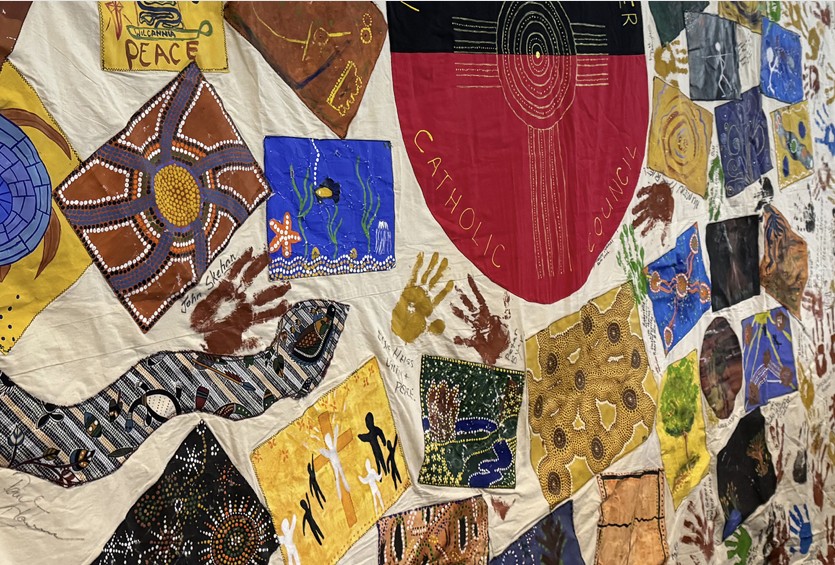
NSW AICC Artwork displayed at the 2025 NATSICC Assembly
This is a statement from the National Aboriginal and Torres Strait Islander Catholic Council on Australia Day.
Each year, as 26 January approaches, Australians reflect on this day in different ways.
For some, it is a time of celebration and national pride. For others, it is a time of reflection, grief, or unresolved questions about our shared history.
The National Aboriginal and Torres Strait Islander Catholic Council (NATSICC) acknowledges and respects that this day carries different meanings for different people, shaped by culture, history, memory, and lived experience.
For many Aboriginal and Torres Strait Islander Peoples, 26 January remains a day of mourning and a reminder of the ongoing impacts of colonisation.
At the same time, many people choose to come together as community in ways formed by their own journeys and circumstances, either through cultural practice, shared connection, or quieter acts of remembering and being together. These moments hold both sorrow and resilience, truth and hope.
In 1986, Pope St John Paul II addressed Aboriginal and Torres Strait Islander Peoples at Blatherskite Park in Alice Springs, affirming the dignity, cultural richness, and enduring place of Australia’s First Peoples.
He reminded the Church that it cannot be fully itself without the contribution of First Peoples. Forty years on, this address continues to shape NATSICC’s call to the Church to approach 26 January with honesty, humility, and a commitment to listening, reflection, and justice.
It also invites us to ask honestly whether, over these past 40 years, we have done all that we might.
Contemporary Australia is home to the world’s oldest continuing cultures and to many generations who have come from across the world to make their lives here.
It is a nation of many stories, languages, and traditions – a place that invites ongoing reflection about belonging, shared identity, and how ancient cultures are honoured alongside a diverse and changing population.
NATSICC recognises and knows first-hand the persistent disparities experienced by Aboriginal and Torres Strait Islander Peoples in areas such as health, education, housing, and life expectancy, and acknowledges that reconciliation remains unfinished work.
At the same time, there are signs of hope. Across Australia, many local communities are rebuilding relationships through dialogue, cultural renewal, and practical cooperation on Country.
The commencement of Treaty in Victoria/Narrm represents one significant pathway, among several, being pursued, while in South Australia the establishment of a First Nations Voice to Parliament has opened another avenue for participation and shared decision-making.
Alongside these efforts, young people are increasingly expressing leadership through art, storytelling, and advocacy, offering fresh vision for the future.
Today, Australians find themselves living in a time of heightened complexity. Global uncertainty, acts of violence both on our shores and in different parts of the world, and the growing pressures faced by families have shaped a national mood in which questions of belonging and identity are felt more acutely.
In such times, NATSICC believes it is especially important to approach difficult conversations through a lens of faith and with care, compassion, and a commitment to listening.
Within the Church, NATSICC has represented Aboriginal and Torres Strait Islander Catholics for nearly 30 years. With the voluntary support of schools, parishes, and partner organisations, NATSICC continues to work closely alongside Australia’s Bishops to strengthen relationships and support meaningful pathways toward reconciliation.
Last year, more than 300 Catholics gathered on the lands of the Wonnarua People in the Diocese of Maitland-Newcastle for the NATSICC Pilgrims of Hope Assembly – a powerful expression of unity and shared commitment that offered a tangible sign of hope for the future of our Church.
Guided by our faith, NATSICC invites individuals and communities to foster respectful conversation, support truthful education, listen to young voices, and take practical steps to address racism, as part of building a more just and inclusive nation.
Echoing St John Paul II’s vision, Pope Leo, in the opening days of his ministry in 2025, said:
“We want to be a small leaven of unity, communion, and fraternity within the world. We want to say to the world with humility and joy: Look to Christ! Come closer to Him! Welcome his word that enlightens and consoles! Listen to his offer of love and become his one family: in the one Christ, we are one. This is the path to follow together.”
As a Catholic faith community, NATSICC also recognises that genuine reconciliation is not only social or structural, but deeply personal and spiritual.
A sense of real inner healing – where truth is named, wounds are acknowledged, and dignity is restored – helps to foster true freedom through Christ. This healing does not erase pain or history but allows individuals and communities to move forward without being bound by it.
In Christ, healing opens the way for forgiveness, and the courage to walk together toward a future shaped by justice, mercy, and hope.
On January 26, we take up that call in Australia by choosing to listen before we speak, to stand beside those who carry pain, and to build communities where truth, justice and friendship can grow, trusting that in Christ we can become one family.
Resources for parishes can be found here