
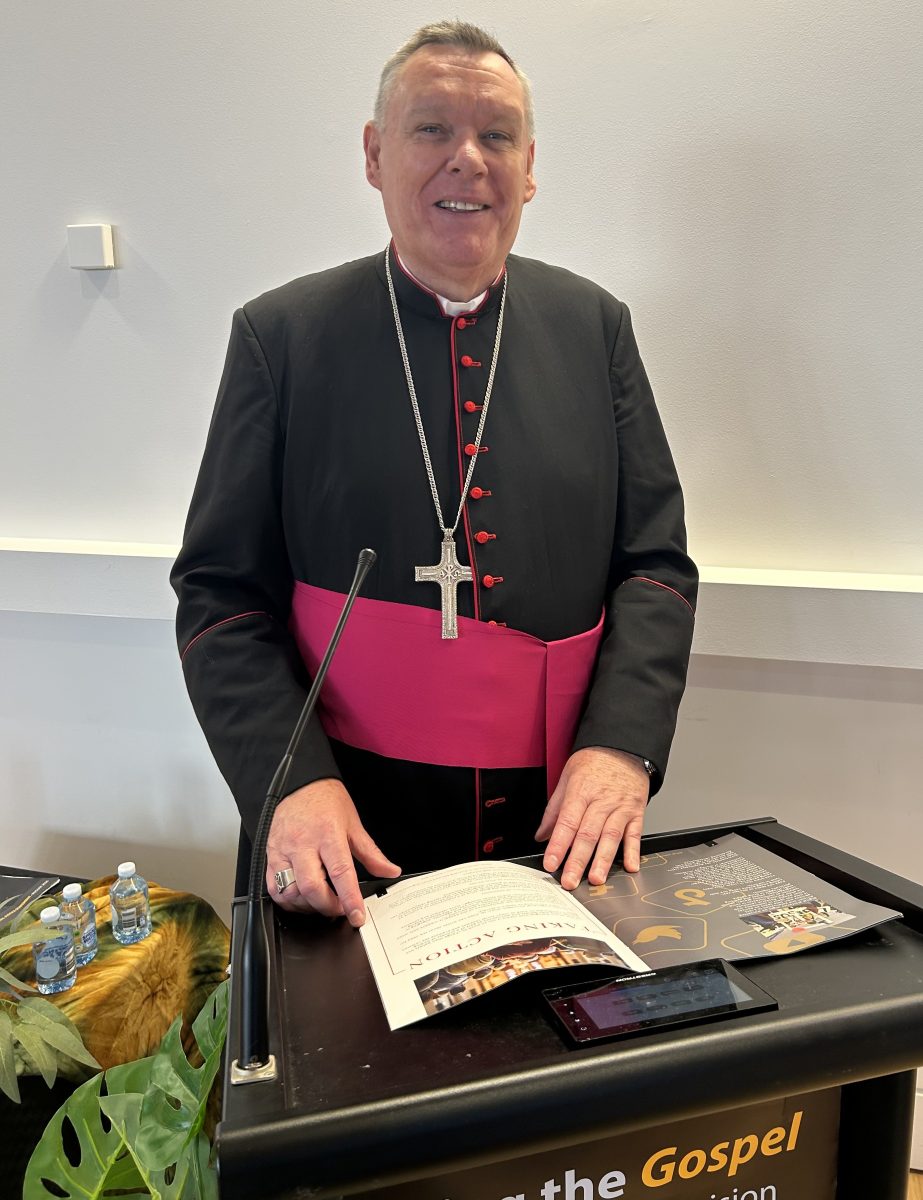
This is the full text of the address by the chair of the Bishops Commission for Social Justice, Mission and Service, Bishop Tim Harris, at the launch of the social justice statement, Living the Gospel in Times of Social Division, in Brisbane on August 7, 2026.
We gather today with hope, compassion and a shared desire for a more peaceful, united Australia.
Yet many in our community carry pain amid growing division.
The dreadful massacre at Bondi last December, and the abuse directed at Muslims, migrants and refugees, Aboriginal and Torres Strait Islander Peoples and all those we too readily consider to be “other” – whether because they are unborn or elderly, living with disability, or come from a different nationality, religion, or background – remind us that polarisation wounds the dignity and well-being of all Australians.
We see this division every day, especially online, where anger, misinformation and hateful attacks spread very quickly.
Our country needs a change of heart: one that offers hope, and healing and a way beyond fear.
The statement from Australia’s bishops, which we launch today, offers guidance to the People of God on how we might respond.
Last October, Pope Leo reminded us that “the supreme rule in the Church is love”.
In this, he echoes the teaching of Jesus: love God with all your heart, soul and mind, and love your neighbour as yourself.
For two thousand years, Christians have tried to live by that command. St Maximillian Kolbe, quoted at the beginning of our statement, gave his life in love amid the horrors of the Nazi regime.
And even on that dreadful night at Bondi, love was not absent.
As gunfire broke out, Mohammed Rahmat Pasha, a young Indian Muslim, arrived at the scene and began helping the wounded, despite the danger around him.
While others ran for safety, he stayed to help … and he helped so many.
Later, he said his actions were guided by faith and humanity: “Saving an innocent is saving all of mankind.”
After the attack, when the New South Wales Government asked Jewish faith leaders what they needed, they asked for positive action.
Rabbi Nochum Schapiro offered a simple response: let every person perform one mitzvah, one act of kindness and love, in memory of those who could no longer show kindness to others.
That is at the heart of our message today, my dear friends.
Love is not only a word or a feeling. Love is action. It reaches beyond what is familiar and comfortable.
It listens to others’ stories, fears and hopes. It builds bridges of understanding. It dispels ignorance. It offers forgiveness and extends grace., it helps heal communities.
So, in the face of hatred, division and violence, we invite you to go into your communities with kindness, friendship and a listening ear.
This is the culture of encounter Pope Francis called us to build. It is the path beyond polarisation.
In his first encyclical, called Magnifica Humanitas, Pope Leo in recent months warned of a global culture of power marked by polarisation and violence.
His response is a civilisation of love: a society where justice and charity belong together, and where love guides our economic, political and cultural life.
The Holy Father offers us five paths on which to journey towards the civilisation of love.
Firstly, he urges us to be mindful of what we say and what we write. The way we communicate is of fundamental importance. Belligerent and aggressive words, laden with prejudice, words spoken in anger, are surely the enemies of what is truly good.
As the Pope points out, we have a real opportunity to contribute to the common good each time we speak the truth. We should support those in need of comfort, denounce injustice, and give a voice to the voiceless.
Secondly, building true peace on the foundation of justice – a peace which demands much more than the absence of violence. Peacemakers never grow weary of seeking justice. There is no peace without justice, as Saint Pope John Paul II said.
The third path the Pope encourages is to adopt the perspective of victims. There are times when we cannot stay silent or neutral. When grave injustice is perpetuated, we must take a stand and announce it, ensuring that the voices of victims of conflict and injustice are heard also contributes to the restoration of their dignity and helps to prevent the normalisation of conflict in human affairs.
Fourthly, he speaks of cultivating a healthy and authentic realism, one which is neither idealistic or cynical. Authentic realism never gives up on the dream of changing the world.
The Pope says, “It begins by clearly identifying interests, fears, the construction of power dynamics, precisely in order to determine what can be achieved, and the measures needed to achieve it. It does not reduce politics to morality; neither does it surrender to violence. Instead, it seeks viable paths for making peace more than a mere word, through credible institutions, verifiable guarantees, patient negotiations, conflict prevention and the protection of civilians.”
And finally, the Pope encourages the revival of dialogue at all levels of society, and indeed globally. We have to put encounter and dialogue at the heart of this statement’s recommendations for practical action to help heal divisions in society.
Encounter and dialogue are sorely needed to build peace in local communities, to break down, and to foster harmony between people of different faiths.
There is no place for resignation in the face of the divisions which beset society today. None of us can say that we are all too small and insignificant in the scheme of things to do anything worthwhile.
All of us have spaces where we can have a positive impact. We all have a part to play in building that civilisation of love.
As bishops, we can act at the national level. This social justice statement we launch today, Living the Gospel in Times of Social Division, is one contribution to that conversation.
But perhaps what Australia needs most at this moment is not simply more debate.
The gospel offers us a way. We’re offering that today. The measure of our nation will never be how loudly we argue, but how deeply we care for one another, especially those on the margins and those whose voices are seldom heard.
This statement invites us to that vision: a society where disagreement need not destroy respect, where diversity is welcomed as a as a great gift, and where the dignity of every single person is the foundation of our common life.
(And again, we’re accused at times of when we speak in that way of somehow being ‘woke’. I have no idea where that word’s come from, by the way, and it actually can be used in a negative way to silence conversations like this. ‘Oh no, that’s woke talk’. It’s the talk of Jesus Christ, the gospel, and that’s what we’re trying to speak today.)
So today, we urge all Christians, all people of goodwill, all people of faith, and all people across this country – let us reach out with friendship. Let’s listen to one another. Let’s embrace one another. Let’s appreciate the gifts of each other. Let’s show some empathy and compassion to one another. Let’s choose encounter over division.
Let’s choose compassion over fear. Let’s choose hope over hatred. Let’s build understanding. Let’s commit ourselves to a society that respects and upholds the dignity of every human life, where every person, whatever their background, race, or religion, can flourish and live in dignity.
Doing so, we will help build the civilisation of love to which Pope Leo calls us, and we will become the Australia that future generations deserve.
May God, who loves us beyond imagining, fill us with love and guide our feet into the way of peace.
Thank you
(Photo of Bishop Tim Harris courtesy of Mary Macuga, Archdiocese of Brisbane)