
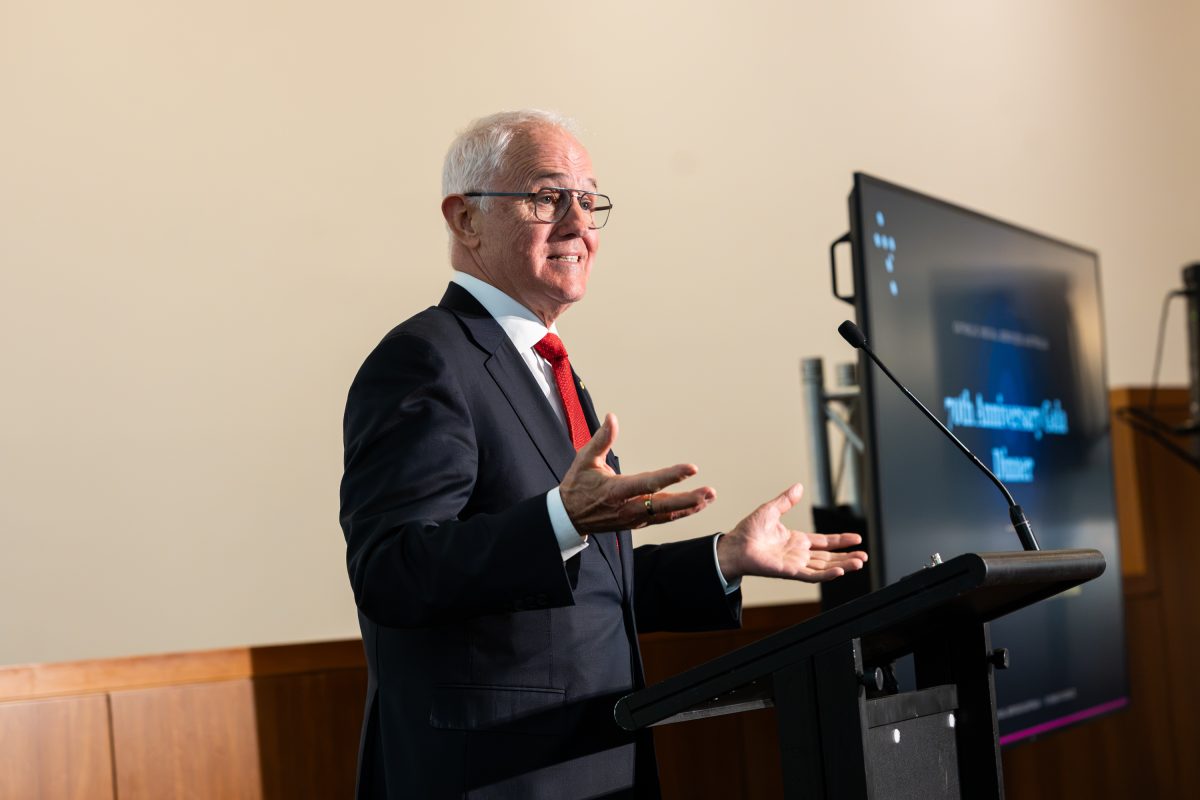
Malcolm Turnbull speaks at CSSA anniversary dinner (Image: Paul Chapman)
This is the full text of the McCosker Oration delivered to mark the 70th anniversary of Catholic Social Services Australia by former prime minister Malcolm Turnbull.
Thank you, Jerry Nockles for that kind introduction.
Thank you, Aunty Caroline, for the Welcome to Country. About ten years I spoke in the Ngunawal language in the House of Representatives, the first PM to do so. Your family taught me the words:
Yanggu gulanyin ngalawiri, dhunayi, Ngunawal dhawra.
Wanggarra lijinyin mariny bulan bugarabang.
‘We are meeting together on Ngunawal land country and we acknowledge and pay our respects to their Elders.’
You are assembled here in Canberra under the theme “Building for the Common Good” and as you do celebrating the 70th anniversary of Catholic Social Services Australia whose founder, Monsignor McCosker is remembered and honoured by this Oration in his name.
Frank McCosker was a Catholic Chaplain with the 15th Brigade during the Second World War. In 1956 he became a founding member of the National Catholic Welfare Committee, which grew to become Australian Catholic Social Services.
At mass on Sunday I told our friend Monsignor Tony Doherty that I was speaking to you this week and he spoke to me warmly and with admiration of your work, about Frank McCosker, about Mary Lewis, Father John Davoren and Monsignor John Usher.
And when I told him I was going to speak about the politics of love he offered me this reflection from Carlo Martini, Cardinal Archbishop of Milan:
“The beauty that will save the world is the love that will share the pain.”
All of you honour Frank McCosker’s life not by words, let alone orations, but with the practical love you manifest, sharing the pain, every day of your work.
Framing the Challenge
The challenge of living the Gospel is especially hard today, as the Bishops have said, in these times of social division.
Their recent Social Justice Statement, informed by Pope Leo’s recent Encyclical, frames the challenge. How do we bring people together, how do we maintain and advance our solidarity in a time when so many forces are seeking to pull them apart? How do we manifest our Christian love for all God’s creation at a time when we are surrounded by so much hatred.
The Politics of Love
But first let’s talk about love – the politics of love.
We don’t speak about love enough anywhere, and certainly not in this place.
Noting that the Greek word for love in the New Testament is αγαπη people will often say this is a subtle Greek word speaking of an unconditional, spiritual love.
And while I would never want to take anything from the subtle ingenuity of the Greeks, this short sells the radical nature of Jesus’ message about love: unconditional, unlimited, seeking nothing in return.
Agape is a Greek word, but it had almost no usage as a noun in Greek literature until Greek speaking Jews in Ptolemaic Alexandria, hundreds of years before the birth of Christ, translated the Hebrew scriptures into Greek for a Jewish audience who spoke and read Greek. This translation known as the Septuagint was the biblical reference point for the Greek speaking authors of the New Testament.
The translation renders the Hebrew word “ahab” meaning love as “αγάπη ” which is a noun derived from a common Greek verb αγαπάω used as early as Homer’s time to mean conferring esteem, affection. It was a neutral word not loaded with overtones of sexuality like έρως or close mutual affection between friends like φιλιά . But in the Septuagint both the verb and the invented noun is used for all types of love and affection whether it is of God, or of man for a woman (Jacob for Rachel), between two friends (David for Jonathan) or even (Isaiah 1:23) corrupt rulers ἄρχοντές loving bribes ἀγαπῶντες δῶρα.
It is much the same as our term love in English, the meaning of which is dependent on the context. Love of God, love of my wife, love of my football team, love sleeping in on the weekend.
Context is everything.
Again and again Jesus tells us to love strangers, sinners, enemies, to love unconditionally and without seeking anything in return.
It is easy to forget how truly radical was Jesus’ message about love – the three synoptic Gospels relate the dialogue with subtle differences but in conversation with a lawyer Jesus says (or confirms) the greatest commandment is first to love the Lord your God with all your heart, your soul, your mind and strength and second to love your neighbour as yourself. “There is no commandment greater than these” [Mark 12:30] or “On these two commandments hang all the law and the Prophets” [Matt 22:40] And they are bound together – our love of God is manifested by love of others.
And when in Luke’s Gospel the lawyer asks who is my πλησίον neighbour, Jesus answers with the parable of the good Samaritan who comes to the aid of the Jewish injured by robbers who is left unassisted by fellow Jews who had just passed him by. Jesus concludes the parable asking: so who was the neighbour to the man who was beaten up by the robbers, implicitly asking was it the people with whom he shared a religious identity perhaps – the two who passed by? The lawyer replies it was the one who showed him mercy – the complete and utter stranger, the Samaritan.
As John writes: The one who does not love has not known God because God is love. (1 John 4:8)
ὁ Θεὸς ἀγάπη ἐστίν
So we are closest to God when we are loving, that is the very core, the beating heart of Jesus’ message. God is love and we are closest to God when we are filled with love, and like the Good Samaritan doing something about it.
The Threats we Face – Is Love up to It?
It is easy, almost reflexive, for people (especially politicians) to blame the media for the troubles of their times. But as Enoch Powell said1 “For a politician to complain about the press is like a ship’s captain who complains about the sea”.
So treat this less of a complaint but as an objective assessment of the state of the sea on which we are all embarked in our, and our world’s, journey.
Most of us grew up in a world where we learned about the world through a relatively small number of curated media – newspapers with editors, radio and television with producers and directors.
And there was plenty of angertainment in that world too – hate, fear and lies have always been our vulnerability. Some people allow themselves to be almost entirely motivated by hatred, it’s what gets them out of bed in the morning – too many with that disposition have walked these halls over the years.
But at least in that old media landscape, in which I worked as a young journalist, the publishers and broadcasters had a vested interest in acquiring a wide audience – the first edition of the Sydney Morning Herald proclaimed its credo in lines from Alexander Pope “In moderation placing all my glory, while Tories call me whig and whigs a Tory”. The old Fairfaxes were not especially broad-minded but they needed the biggest possible audience to justify their advertising rates.
Broadcasters were often subject to regulation requiring them to be accurate and balanced in their reporting, to be decent (by the standards of the day) and to be owned by fit and proper persons. The ABC still has a statutory responsibility to ensure its news and information is “accurate and impartial according to the recognised standards of objective journalism” [Section 88(1)(c) Australian Broadcasting Corporation Act 1983].
But in the last twenty five years or so the media environment has utterly changed, and the pace of change has continued to accelerate.
Critically, the cost of producing and disseminating news, information or any content has dramatically reduced so that there is more news gathering, editing and broadcasting power in my smart phone than there was in all of Channel 9’s news team, studios, and transmitters when I was television reporter fifty years ago.
So not only is narrowcasting made viable in every form of curated media so in the uncurated “social” media domain there is presented a near infinite variety of content of every format, length and disposition.
The media landscape, which is to say all our respective windows on the world, is more crowded and chaotic than ever. There is the most intense competition for attention – it is an attention economy.
And the algorithms whether they are automated on the social media platforms or in human form in the curated media, are focused on keeping your attention and they do this with anger, outrage, resentment, anything to rile you up – angertainment.
All of this makes for an objectively more polarised and divided community.
We are all too often locked in our own little media bubbles with content confirming and aggravating every grievance or angry prejudice.
So we are not sharing the same news or indeed the same facts. The reasonable, centred, respectful and informed voice of moderation is not going to get as much attention as the wild eyed rage and drama.
As people sink further and further into their own digital rabbit holes their exposure to alternative points of view actually diminishes – which is the exact reverse of what we thought the Internet would bring.
Worse still the lack of direct human contact, its replacement with digital anonymity strips away empathy, and so you will see people saying things online, sharing things online they would never say to someone’s face.
Social cohesion frays, our sense of the common good is undermined and so is it any wonder that in the midst of so much remarkable material wealth, and able to communicate with pretty much anyone in the world, many of us, too many of us, are more isolated than ever.
So are we all doomed? Is our society irretrievably broken?
Our parents’ generation invented the nuclear technology that could have destroyed the world – but didn’t. Has our generation invented the digital technology that will destroy our society?
Love is the answer
Love is the answer. As the motto of the Wayside Chapel says “Love over Hate” but we can’t just sit back and wait for Love to triumph, like the Good Samaritan, like all of you, we have to make sure Love does indeed triumph.
The Bishops’ Social Statement drawing on Pope Leo’s recent and magnificent Encyclical – Magnifica Humanitas all point the way, but let me offer my own thoughts which will I hope resonate with those.
There are good things we should do, and do often, and use all the modern communication tools to do. And at the same time we should not be afraid of calling out those who are peddling hatred or telling lies or treating people with disrespect. Calmly and with courtesy of course. We should refrain from words that offend and hurt offers – but courtesy should take second place to honesty.
If at the heart of what we do is love for others, then that means respect for others and that means we should tell the truth. This is how you build trust, absolutely vital for any leader, any government, any organisation – sacred or secular.
Trust is built on truth and transparency.
Let me give you an example from my own political experience. When the Liberals returned to government in 2013 under Tony Abbott I was the Communications Minister and inherited the NBN. As so often happens with big projects, progress had been very slow and the previous government had invented an ingenious set of new terms and statistics that altogether were designed to create the impression that a lot more was being done than in fact was.
So I created a simple spreadsheet, to be updated every week, which showed how many premises were passed with an NBN cable or became able to access an NBN wireless station or satellite, and how many of these were actually connected. In each technology.
After about six months one of my officials said they thought I was the only person who read the spreadsheet. “Keep publishing it”, I said, and they did. The point was once people were satisfied we were telling the truth and being transparent about it, they did not need to read it. They trusted what we were saying about the progress of the build.
Calling out and rebutting falsehoods
In the old days it was often said that it was better to ignore lies and falsehoods lest the rebuttal give them oxygen. To our cost we took that approach in the 2016 election when faced with the Mediscare – the claim that the Coalition would sell Medicare. In fact because of the way viral digital media is targeted this falsehood had considerable impact on older, sicker, poorer voters.
We learned that falsehoods need to be rebutted quickly and emphatically. And so in subsequent byelections we did just that.
The AEC you may have noticed has taken the same approach with falsehoods about our election machinery – conspiracy theories are jumped on and contradicted with facts before they get too much headway.
Courage can be called on.
Lucy and I saw a great example of that in the New York church of St Ignatius Loyola on 26 April this year. The pastor, Father Dennis Yesalonia, did not mince his words:,
“You may have heard of Christian Nationalism. Let me assure you it is not Christian. It is an evil ideology that tries to mislead those who profess their faith in Jesus Christ.
We hear that message loudly through our Holy Father. Jesus Christ is not a proponent of war and death. Jesus Christ does not lead us to bigotry and hatred and jingoism. Jesus Christ does not condone bombing or hatred of our brothers and sisters”.
Rather, he concluded, we follow our Christian faith “by being messengers of hope and love and compassion and mercy to one another”.
Advocacy
As advocates our job is to get a good message across in a way that is appealing and convincing.
I once had a very hard working employee, a young man, who worked all hours. He was married and his wife had a baby and I encouraged him to spend less time at work and more time at home with his family. Unconvinced, he looked at me as though I was a sentimental old man (I was in my late 40s!). So I asked him: why do you work so hard here at Goldman Sachs? Is it to make a lot of money? He said it was. Well, I said, if you keep going like this your lonely and neglected wife will so tire of your indifference that she will divorce you and take most of that money.
He sat bolt upright, as though he had been electrocuted. And he did improve.
Often the key to advocacy is the connection of empathy, the personal story, a human dimension and a human connection. Jesus’ parables are filled with empathy, stories about sewing seeds, gardens, sheep – they mean so much to us, imagine how they connected to people whose whole world was agriculture.
So when we make the case against those who spread hate it is not enough to say “This is unChristian” or “this is wrong” we should point out graphically where hatred leads you – to a breakdown of society and to violence of the kind we see in other countries not very different from our own.
Polarisation has increased dramatically in the United States. In 1960 just 5% of Americans said they would be displeased if their child married outside their own political party. By 2010 it was 41%. Today, 72% of Republicans regard Democrats as more immoral (up from 47% in 2016) 63% of Democrats say the same about Republicans up from 35% in 2016.
A parliamentary democracy is designed for, and depends on, compromise. How can you compromise if you think your opponents are not just mistaken but evil or immoral. How can the rule of law protect the minority if the majority are persuaded the minority is evil?
Respect for each other, disagreeing agreeably, civility are aspects of love but they are also essential parts of the democratic society we enjoy.
When hate tests our resolve
Bondi Beach. I know it well, among my earliest memories are of my father and the surf club, walking on the sand, the easy egalitarian familiarity of that very Australian place. It is part of the community where Lucy and I have always lived, and which I represented in this place for 14 years.
I said in my maiden speech that in Wentworth our prayers fly to heaven in the language of the old testament and of the new testament and, once a year at St Patrick’s Bondi, in the language of the angels themselves…… or so the Irish assure us.
And part of that experience is many Chanukah celebrations at Bondi with a mostly Russian Jewish community.
I once gave a short speech in Russian the punch line of which was comparing Bondi to Odessa – the old men all laughed whether it was at the joke or my bad Russian. It didn’t matter.
This to me was Australia.
And so the terrible attack on the Jewish community last Chanukah was a shocking act of anti-semitic violence – an attack on every single one of us.
But reeling from the violence and the hatred those two assassins brought to Bondi, we must not lose sight of how police, bystanders, lifesavers, passing members of the public rushed to the aid of the victims. How in the midst of this terrible act of hate we saw, as we have before, so much love – unconditional and selfless.
And when the usual suspects used this attack to launch a new round of attacks on migrants and especially Muslim migrants and urged that there should be no migrants from non-democratic nations, let us not forget that of the two Muslim men who carried out that attack, one was born in Australia and his father had migrated here from India, the world’s largest democracy.
And the man who disarmed one of them – the hero, Ahmed al-Ahmed – had come to this country as an immigrant from Syria, then ruled by the tyrannical Assad family and a hotbed of terrorism.
And among the victims that day were Jewish Australians who had fled the thoroughly undemocratic Soviet Union.
The race, religion or nationality of an immigrant tells us nothing. Character and contribution are what matter.
We will not defeat the vile hatred of anti-semitism with hatred of other Australians.
There are those who, in the name of national security, speak hatefully about Muslim Australians or immigrants of people from other cultures, who recklessly and falsely claim multiculturalism has failed and call for a monoculture – this land has never been a monoculture.
They are doing as much for national security as the Christian Nationalists are doing for Christianity.
Let me say to you, not as a theorist, but as a former Prime Minister. The people who spread hateful messages about other Australians, who are seeking to divide Australia on religion, ethnicity or culture, are making Australia less safe.
I made this point directly to Alan Jones when I was in Parliament, those who demonise Muslims are nothing more than recruiting sergeants for extremists. Every extremist group is saying to its potential recruits – you are not wanted here, you are not Australian, this is not your community – join us.
Hate is never an answer to hate – it is like throwing kerosene on a raging fire.
It is love, solidarity, friendship and understanding that can bring us together. Or as the Bishops have said committing ourselves to a culture of encounter, of empathy and respect.
This speech is billed as an oration and speeches like this have their place I suppose. But we need more engagement with each other, pulling ourselves out of our phones and those digital echo chambers in which so many people can be trapped losing touch with the real world.
Cicero contrasted the formal speech, with conversation, sermo, from which of course our word sermon is derived. But I prefer the word homily, which comes from the Greek word for conversation – as in that on the road to Emmaus και αυτοί ωμιλουν προς αλλήλους περί πάντων συμβεβηκοτων τούτων – and they were conversing with one another about the things that had happened. [Luke 24:14].
As we travel along our lives’ journey we should be conversing, sharing and listening, and always seeking to be as Father Yessalonia said in April “messengers of hope and love, compassion and mercy.”
ENDS